
Upper Dublin City Directory Collections
Upper Dublin Township is a municipal geography, not one verified printed directory title. Its official geography uses portions of Abington, Ambler, Ardsley and North Hills, Dresher, Jarrettown and Maple Glen, Fort Washington, Oreland, and Willow Grove postal communities. A useful city directory search therefore begins with the place printed on the historical address, then expands to township and county sources. The verified material below is a research path, not a claim that every collection lists every Upper Dublin household.
| Collection | Years | Where Held | Access |
|---|---|---|---|
| HSMC Norristown City Directories | Documented use, 1908-1931; examples around 1898 and 1927 | Historical Society of Montgomery County | Institutional inquiry; confirm postal-place coverage |
| Fort Washington subject files | 1832-2010 | Historical Society of Fort Washington | Finding aid and repository inquiry |
| Fort Washington manuscripts and deeds | 1721-1978 | Historical Society of Fort Washington | Repository inquiry for local deeds and organizations |
| Upper Dublin tax lists and deed indexes | Tax lists from 1785 with stated gaps; deed indexes 1784-1877 | PA State Archives / PHMC guide | Series identification, FamilySearch-accessible selections, or on-site microfilm |
Montgomery County Archives is another documented fallback for pre-1906 births and deaths, older marriage and probate material, and microfilm. Released federal census schedules supply a household check after 72 years. Together, those sources cover more ground than an assumed township directory run.
Upper Dublin Directory Place Names
Use the postal-place label as a retrieval clue, not as a statement of jurisdiction. Fort Washington, Ambler, Willow Grove, and other labels can appear in historical material for places inside Upper Dublin. An Ambler heading needs special care because Ambler Borough is a separate municipality even though 19002 reaches township portions. The Township Historic Resource Inventory also shows Upper Dublin historic addresses under several postal cities. Write down the exact heading, spelling, street form, and year before moving to another source.
For an older property, the Upper Dublin Historical Commission links a Historic Property Research Guide and Historic Resource Inventory. Its material can furnish an address form, approximate construction era, or historic name to try in library and archive catalogs. It is a lead, not title or occupancy proof.
Upper Dublin Directory Archives
The Historical Society of Fort Washington is the clearest local repository for a community now within Upper Dublin and Whitemarsh. Its University of Pennsylvania finding aids describe 16.75 linear feet of subject files on churches, schools, businesses, monuments, family genealogies, research aids, mills, and farms. Separate collections include photographs and film from 1885-2002 and manuscript volumes and deeds from 1721-1978. Those descriptions help frame a targeted inquiry by surname, road, business, church, farm, or organization.
The Fort Washington finding-aid results show collection paths that connect Upper Dublin places with people, deeds, and local organizations.
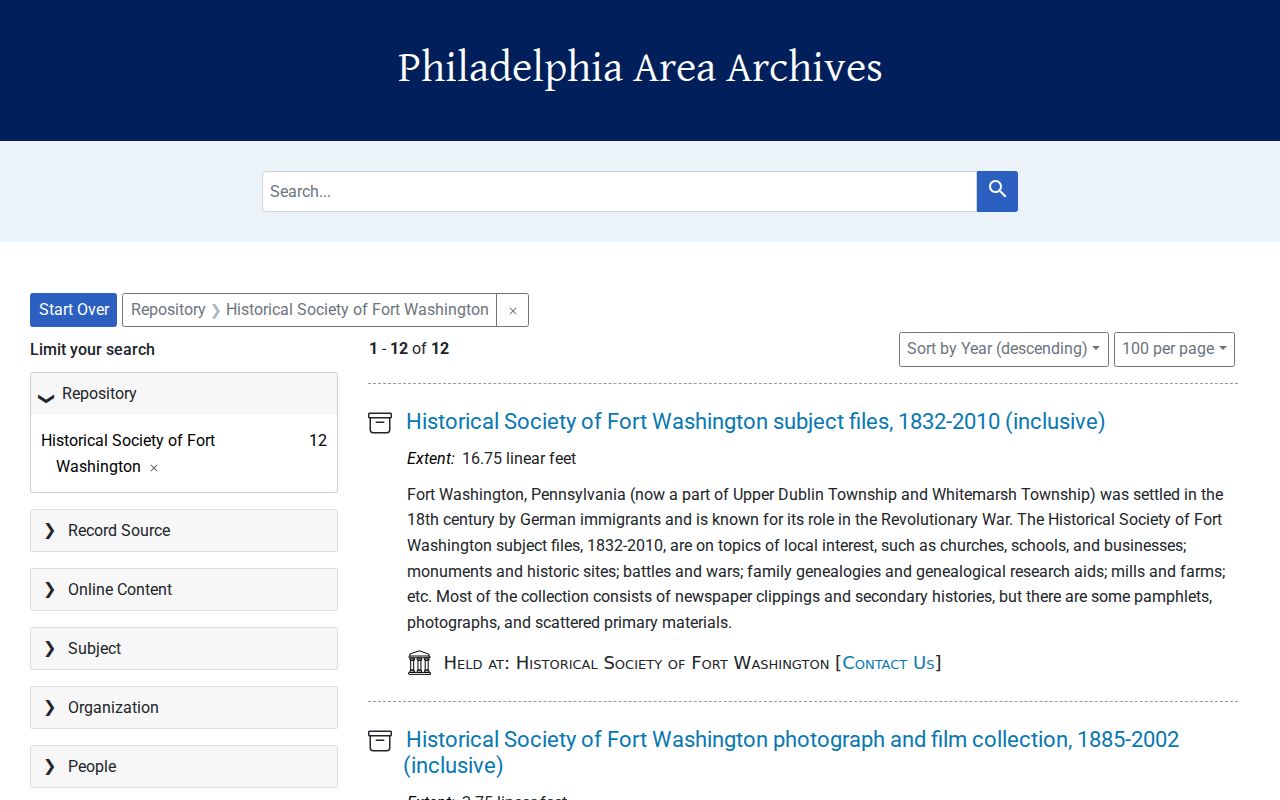
Start with the finding aid's subject terms, then ask the repository whether the relevant folder, volume, or deed can be consulted. A finding aid is a discovery tool, not a household index.
Upper Dublin Directory Years at HSMC
The Historical Society of Montgomery County provides a valuable but limited directory example. Its own research describes Norristown City Directories used to follow the Dill Co. through the “Patent Medicines” heading from 1908 through 1931, with other examples around 1898 and 1927. That evidence confirms local directory work and shows the sort of fields a volume may preserve. It does not establish a full county series or promise that a Fort Washington, Ambler, or Willow Grove household appears in the same run.
Ask the Society, at 1654 DeKalb Street in Norristown, about the exact community and time period before treating a city directory as an Upper Dublin source. Their published telephone number is 610-272-0297. The question should name the postal place, date span, and whether a residence, telephone, business, or reverse listing is needed.
Montgomery County archival retrieval guidance is also useful when the needed record is an older county series rather than a printed directory.
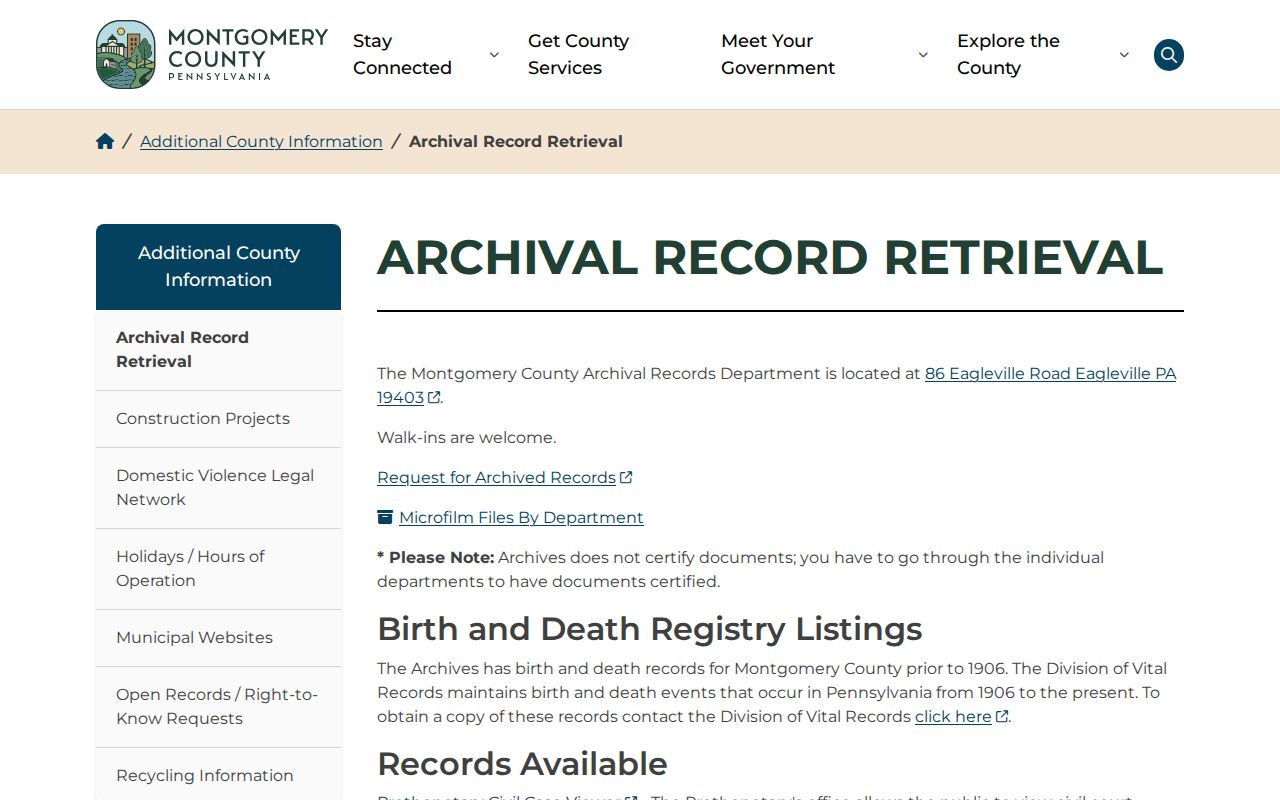
Archive retrieval is most effective when the request gives the known surname, address or postal place, approximate year, and record series sought.
Reading Upper Dublin Directory Entries
Read the entry and its heading together. HSMC's documented example identifies the Dill Co. or Dill Medicine Co. in a “Patent Medicines” category, names C. H. Alderfer as president, and distinguishes the business from Dr. Wallace W. Dill’s separate Norristown address. That is a sound sample inventory because it records what the institutional narrative actually described. It also shows why a business association should be checked before it is called a residence.
| Business name variants | Dill Co. and Dill Medicine Co. appear in the HSMC narrative. |
|---|---|
| Category heading | “Patent Medicines” identifies a business category, not an individual household. |
| Year scope | HSMC described the example from 1908 through 1931. |
| Officer name and title | C. H. Alderfer is identified as president in the institutional account. |
| Place and address context | The narrative separates the company context from Dr. Dill’s different Norristown address. |
Transcribe the publisher or institution, year, page, heading, entry wording, and address exactly. Then test the result against a census, tax list, deed, or other record created for a different purpose.
Upper Dublin Directory Reading Terms
Directory shorthand changes by publisher and year. The source research did not verify a local criss-cross volume, householder index, or abbreviation style for Upper Dublin. Treat these as terms to look for in the volume’s own front matter, never as marks that can be assumed from a different book.
- Criss-cross directory
- A street-order companion to a name-order directory, if the particular volume includes one; no Upper Dublin run was verified.
- Householder index
- An index labeled for household or residence use when a publisher provides one; inspect that book’s title and key before relying on it.
- Abbreviation key
- The publisher’s explanation of shortened words or marks, usually found in the volume’s preliminary material.
- Category heading
- A label such as “Patent Medicines” that organizes business material and does not by itself prove a residential address.
Upper Dublin Directory Era Evidence
Before a suitable printed collection appears, the Pennsylvania Historical and Museum Commission guide supplies a more direct Upper Dublin people-and-place layer. It lists tax records for 1785-1789, 1791-1793, 1795-1819, and 1821-1834, with another 1834-1845 series. The gaps matter. A missing year should be recorded as a gap in the source, not as proof that a person or property disappeared.
The same guide identifies grantor and grantee deed-index microfilm for 1784-1877. That index can link a surname or land description to the county Recorder’s longer deed trail. It is particularly helpful where an early postal place or changing street label makes a directory search thin.
Note: Tax-list and deed-index evidence identifies a taxable resident or recorded party in a stated record, not every person who lived at an address.
Tracing Upper Dublin Directories
For family history, start with an address or surname and a narrow date range. Search under the historic postal community as well as Upper Dublin Township. Record each spelling and street form, then move one or two editions at a time rather than jumping decades. The goal is a dated trail that can be checked against independent records. For a modern parcel-by-parcel trail after the historic work is done, use the Upper Dublin streets directory.
- Locate the earliest likely listing or archive reference, and capture its source, date, page or folder, heading, and exact wording.
- Search nearby editions or files for moves, spelling changes, business changes, and the postal-place label used in each year.
- Pair the closest released federal census with the entry. Census schedules locate a household at a point in time, while directories and telephone books can bridge moves between enumerations.
- Use the County Property Records service for a current parcel locator, then check the Recorder’s grantee and grantor history for recorded owners.
- For early gaps, compare PHMC tax lists, deed-index microfilm, and a targeted Historical Society of Fort Washington or County Archives inquiry.
A name falling out of a directory is only a research question. It may reflect a move, a changed spelling, a different postal heading, a different listing convention, or a gap in the volume. A census, deed, tax record, or archival source provides the necessary check.
Upper Dublin Directory Catalog Check
Upper Dublin Public Library is a township-created free public library, but accessible official material did not verify its city directories, telephone books, criss-cross books, yearbooks, obituary index, newspaper microfilm, or database year runs. The responsible next step is a reference-desk inquiry naming the place, year, and format sought. Do not assume that a catalog omission proves a collection is absent, or that a familiar database is available locally.
The Historical Commission and Historic Resource Inventory remain practical local starting points for an address. Their value is in producing sound search terms and a likely era, which can then be tested in county, state, library, and historical-society collections.
Upper Dublin Directory Record Timeline
No verified first or last Upper Dublin City Directory publication year was located. The local timeline instead shows why researchers need collections from several custodians and eras.
| 1721-1978 | Historical Society of Fort Washington manuscript volumes and deeds. |
|---|---|
| 1784 | Montgomery County and its Recorder office begin; PHMC also identifies early deed books and indexes. |
| 1785 onward | PHMC lists Upper Dublin tax materials, with the documented gaps noted above. |
| 1832-2010 | Fort Washington subject files cover churches, schools, businesses, local history, and genealogy aids. |
| 1908-1931 | HSMC documents use of Norristown directories for its Dill Co. research example, without proving township-wide coverage. |
The Upper Dublin historic-resource ordinance explains the municipal inventory layer that can connect a historic address to these longer research trails.
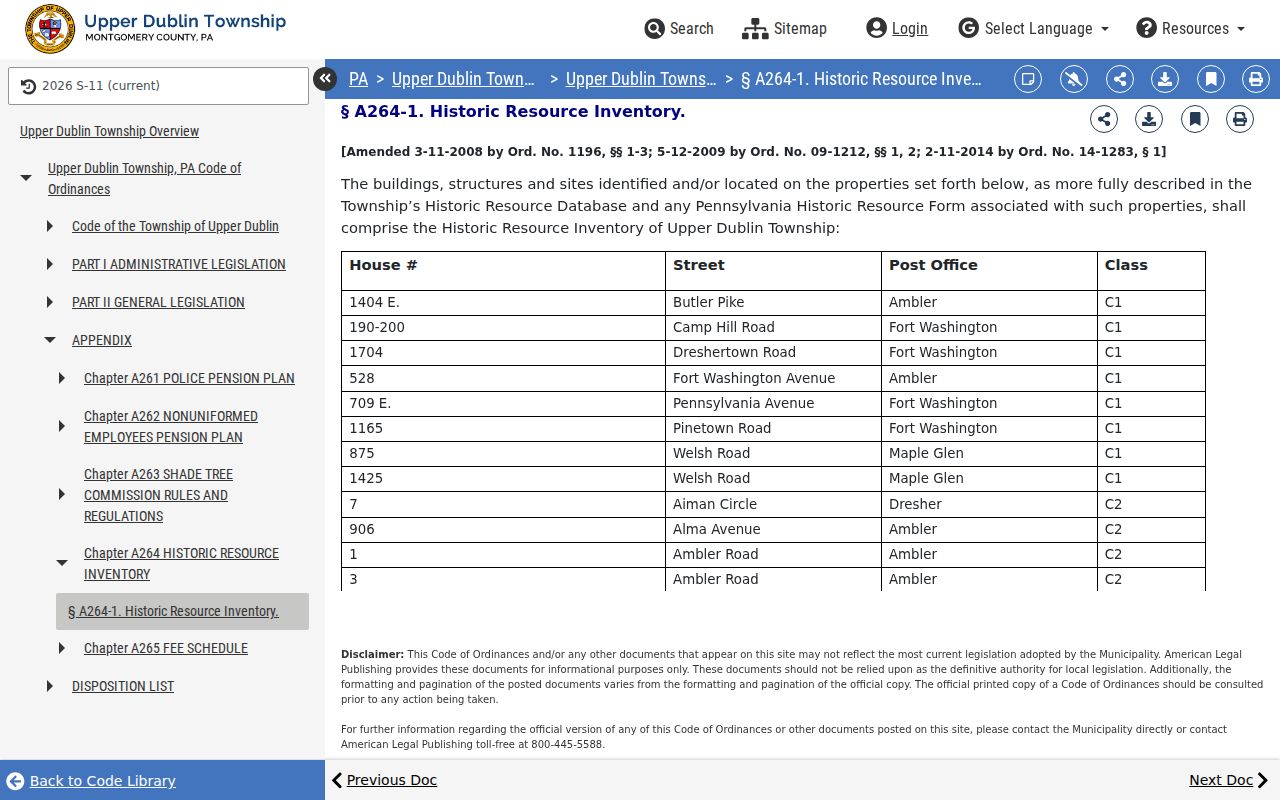
Use an inventory clue as a search term and date estimate, then confirm it in the collection or recorded document that directly supports the conclusion.